Vermont 3.0: Creative/Tech Careers

November 02, 2009

VIDEO: The Vermont 3.0 Innovation Jam

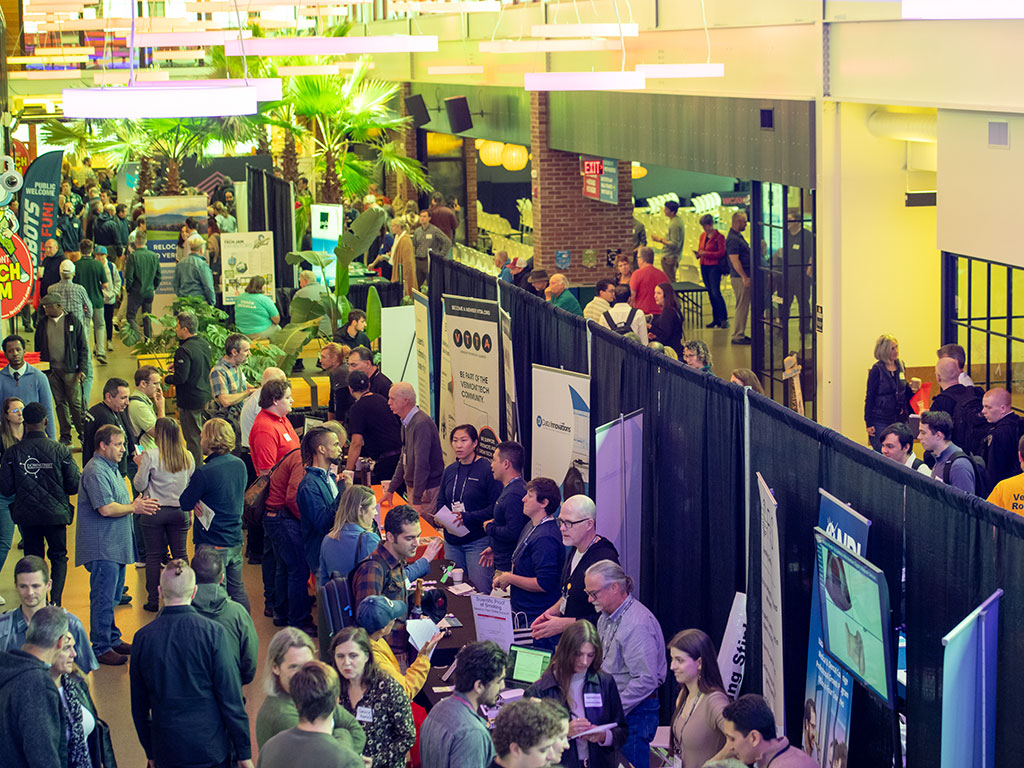
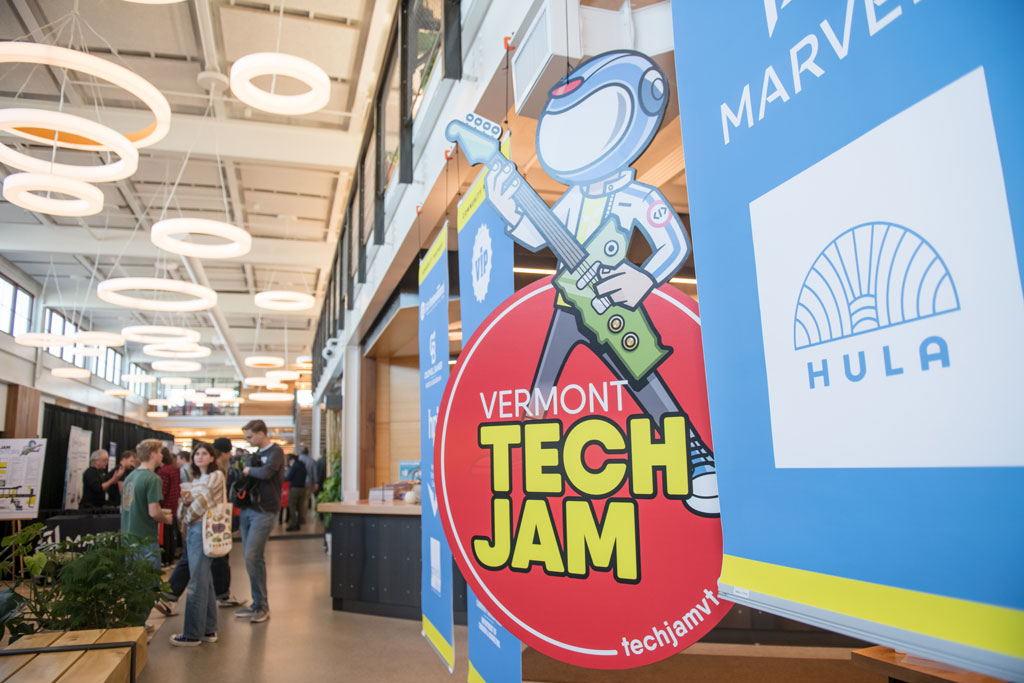
More than 65 exhibitors and hundreds of participants packed the Sheraton Burlington Hotel and Conference Center for the Vermont 3.0 Innovation Jam on October 26, 2009. Here's a video of the event, courtesy of Seven Days videographer, Eva Sollberger.

Seven Days was a sponsor of the event, along with the Lake Champlain Regional Chamber of Commerce, the Vermont Software Developers' Alliance, the Workforce Investment Board, the Vermont Department of Labor, the Vermont Department of Economic Development and Comcast Business Class.

October 28, 2009

Vermont 3.0 Innovation Jam Round-Up

Dancing-firefly

The Vermont 3.0 Innovation Jam — or "the tech jam," as everyone calls it — drew a ton of people to the Sheraton on Monday, October 26. I was inside from 7 a.m. until almost 7 p.m., so I didn't see the parking lot, but I heard it was packed. Seven Days was a sponsor, and an organizer of the event, along with the Lake Champlain Regional Chamber of Commerce, the Vermont Software Developers' Alliance, the Vermont Departments of Labor and Economic Development, and Comcast.

I took a bunch of blurry photos with my iPhone, including this one, of the dancing firefly from VEIC. He's got a CFL bulb for a tail, and he's shakin' it in this photo. I don't know if it's a he, actually. Maybe there's a woman in there. Who knows.

Highlights of the day, in case you missed it:

Continue reading "Vermont 3.0 Innovation Jam Round-Up" »

August 18, 2009

Save the date: Innovation Jam, October 26!

Vt3-1009-savedate-300The next Vermont 3.0 jam is scheduled for Monday, October 26, 10 a.m. - 6 p.m. at the Sheraton Burlington.

Click here to exhibit at the event, or contact Cari Kelley at the Lake Champlain Regional Chamber of Commerce. Hurry — the early bird discount expires on October 1; vtSDA and Chamber members receive an additional discount.

A large number of Vermont’s most successful businesses — many of which are still growing and hiring — were launched by a single individual with a great idea. Vermont 3.0 is celebrating that spirit and how it shapes the state’s economic landscape with an “Innovation Jam” that showcases the coolest companies in the Green Mountains. Not just a job expo, the event will examine the uniqueness of the state’s entrepreneur-founded creative technology companies while acknowledging the start-up drive that lives within each and every one of us.

The day will combine an “Invent Yourself” program designed for budding entrepreneurs, innovative local companies exhibiting and demonstrating their products, and a series of talks by some of the state’s most successful founder-CEOs, including Michael Jager of JDK Design, Microstrain’s Steve Arms, Richard Tarrant, Jr. of mywebgrocer.com, Adam Alpert of BioTek, Lisa Groeneveld of Logic Supply and Paul Millman of Chroma Technology.

Complete schedule and list of exhibitors coming soon... Click here to view a list of last year's exhibitors.

April 03, 2009

Open Source Radio: Behind the Sounds at Vermont Public Radio

Ed. Note: This is the third in Nate Herzog's series of posts about Vermont companies and their creative solutions to technical challenges. Click here to see them all.

Vpr-on-iphone I was especially excited to investigate the technology behind Vermont Public Radio. VPR is my audio feed during my morning commute and it's the only radio station that is played in my house. I've grown addicted to the news in the mornings and the variety shows on the weekends.

When I hear the voices of commentators and reporters, I tend to imagine what they might look like. When I see a picture of the personality, it can be a surprise or a reassuring "a-ha" as I see how close my mental picture matches the real one. Similarly, I had an idea of how the technology must work to produce my favorite radio and I really, really wanted to see how close I came.

Turns out VPR certainly had a lot of equipment I had never seen before, but what struck me was how approachable and usable all of it was.

I spent an afternoon talking with Rich Parker, VPR's Director of Engineering, Jonathan Butler, VPR's Online Manager as well as Communications Producer Michelle Jeffery, and later Robin Turnau, VPR's new President. They toured me around their Colchester studio, explained their various jobs and how they contributed to the overall VPR vision. The whole time the thought kept popping in my head, 'This is open-source radio.'

Hold everything. Open Source Radio? Hear me out. Open source, broadly defined — I know there are many different open source models and licenses out there, but broadly defined — has to be three things:

1. Maintained by the community. Check — VPR is supported and financed in large part through the efforts of their listening community

2. Available for free. Check — VPR content is freely available from a variety of sources.

3. Accessible for improvement or modification. In this case, the source code is the story content. I'll get back to this.

Five years ago, VPR created a five-year plan to evaluate and implement new technology to improve its service. "The thing that is most important to us is our audience and our service to our audience," says Robin Turnau. "In a way, the technology comes second.... For us our primary business is trying to increase our service to the community and our impact in the community. And so we do take a look at whatever technologies we can use to improve that service."

Which begs the question, what exactly is the service that needs to be improved? If radio reception is the service, you put up more transmitters. But what I found is that the VPR service is the stories, the news, the jokes, the interviews, the ... everything. And you don't need a radio to get that. There are a number of ways to get that content — you can listen to analog radio; you can listen to HD radio. You can listen to live streaming right off the website; you can listen to live streaming right off your iPhone or iPod Touch. You can listen with VPR Mobile. You can listen to podcasts of shows. You can read content on VPR.net. You can even pick up a phone, any old phone, and dial 802-735-0565 and yes, listen to VPR.

HD (Hybrid Digital) radio and Internet services are two such ways that I've heard a lot about listening in on my daily commute. HD radio is being rolled out in addition to traditional analog radio, so listeners aren't being asked to retire their analog models. Why go to the expense of rolling out HD radio when analog radio will still be used? And why, if this is radio, would anyone want to listen on the web? Or on a mobile phone?

In a word: mountains.

Mountains play hell with radio signals. Radio works best in big flat areas where receivers have direct line-of-sight access to the towers holding the antennas. When you carve up the landscape with mountain ranges, you not only get a very stunning place to live, you make it really hard to cast a radio signal effectively. So VPR's solution is to give the listening community more ways to tune in. The goal at VPR right now isn't creating a better way to listen. It's creating multiple ways to listen.

But listening to radio with a mobile phone can sound somewhat daunting for some people. "When people start their sentences with 'Well I don't know anything about technology, but...' I like to ask them 'What do you want to do?'" responds Jonathan Butler. "Usually they have a need. Usually they say, 'I can't get VPR classical where I live,' or they say, 'I'm never home with This American Life is on.' For them, it's What's the tool for the job? And there's probably something that can help."

It might be learning how podcasts work. It might be HD Radio.

Picture 1 HD radio differs from analog radio in two ways. One, signal quality is much better in HD. Rich Parker, Director of Engineering (pictured at right), compared the difference between HD and analog to the difference between records and CDs. "On a record you hear surface noise and scratching, hissing and all that kind of stuff," he told me as he twiddled with a Radiosophy HD100 receiver. "With this you just hear the pristine digital."

The second way HD differs from analog is that a digital signal can carry more than one radio channel. 107.9 carries VPR’s news and information service over an analog signal. 107.9 over a digital signal carries that signal, VPR Classical, and BBC World Service on 107.9-HD1, 2, and 3.

Why is this important? Consider what would be needed to run three different channels of content at the same time via analog. You would need to be licensed for three different radio frequencies. You would need three different antennas transmitting the content off one or more towers. Here you get the same content via one channel and one antenna. Say you can pick up 107.9 (VPR News) but can't pick up 90.9 (VPR Classical). That's a problem if you want to listen to VPR Classical with an analog radio, but an HD Radio can pick up both stations over one channel. So the listener gets another way to tune in to their favorite radio.

Listeners can also tune in online.

IMG_3518 "The two things that the website really allows, that benefits listeners, is a lot more choices for how they engage the content on their terms," says Online Manager Butler (pictured at right). "Ten years ago your only option for listening to 'Eye On The Sky' was to wait by the radio. Now you can access content long after its played on the air."

As Butler talks about the ways in which website works, I'm marveling at a known but unspoken fact: he's the only dedicated web person on staff. VPR has this rich content website that updates its content continually as shows broadcast — and there's one guy on staff managing it. That's because VPR is really good at partnering, a skill that can easily elude many businesses today.

VPR partners with The Stream Guys to help stream their content, ClearBearing Inc. to help host their content, and Propeller Media Works and Found Line to design their content. National Public Radio is at the forefront with media technologies and VPR leverages their expertise and infrastructure frequently. American Public Media (producers of favorite shows like A Prairie Home Companion and Marketplace) produced the iPhone tuner application.

VPR staff and volunteers create the content. Lest you thought everyone turned their copy over to some web guru to put it into web format, you're wrong. VPR has a program that allows each producer to easily  
enter their own content. All the stories, pictures, playlists, and audio clips are uploaded by the content producers themselves, usually within minutes of the broadcast. "I never have to crack the whip," chuckles Butler.

Turnau continues, "One of the things the Internet and our website will help us with is engaging our listeners around a story. It may be that we ask our listeners to give us their thoughts about the story. Do you have your own personal story that it's important for us to know about? That's important for other listeners to know about? So it [VPR.net] becomes a gathering place."

A gathering place that could possibly morph into the next phase of community based radio: the community that helps create the content. It starts with the bullhorn, the stories coming over the radio, a one way channel between content and listeners. Then you give the community a chance to offer feedback and comments about stories on the VPR web site. Then listeners start telling their own stories. Sound a little like social media? In fact, this has always been the case with VPR. Anyone could call or write about a story. The technology is giving listeners new ways to do what they've always been able to do.

Listen. Respond. Create.

"Even if we decide not to go down that route [social networking] the decision is not entirely ours," Butler reflects. "The tools are out there. Even if it was something we didn't want to do, we couldn't stop it..... NPR has a fairly robust API which allows anyone to pull and repurpose their content. All of a sudden we have content distributors that are competing with our channels of content distribution."

Which means that it's possible right now to pull VPR content into your own communications channel (give proper credit please). In the future it may be possible to create your own mash up of VPR and NPR stories that energize you and your community. And when you start contributing your own stories, you in effect can create your own content based on what you heard on the radio.

There's another phrase for that. It's called "I heard it on public radio." But because of technology, you can hear VPR anywhere you want to. Listen in on your iPhone when you're in San Francisco. Pull down a live stream when you're in Germany. Listen to a podcast whenever and wherever you are.

And respond. Because there are a lot of Virtual Vemonters out there just like you. And when you do that, you join the community of people who care about the news, who laugh at the same jokes, and enjoy the  
same music. They're all around you.

"The thing for us about our website is that there is just so much material there, so many stories that we've done over the years," says Turnau. "And it's now at the point where we need to do a better job of exposing that and showing people what's there."

Doesn't matter if you're from Vermont or not. Tune in. Log on. You'd be surprised at how much the technology can make you feel among friends.

February 03, 2009

Vermont 3.0 Legislative Forum -- Round-up and Video

Last Wednesday, Vermont 3.0 hosted a discussion between five Vermont CEOs and a group of legislators at the statehouse in Montpelier. I counted about 40 people in attendance, many of them elected officials. The small conference room was packed, and almost everyone stuck around for the two-hour-long discussion.

Turns out it was very timely, considering the recent layoffs at IBM. The audience seemed to find it instructive, hearing from five CEOs of successful, growing local companies who want to continue doing business in Vermont. Senator Ginny Lyons called the discussion "a ray of sunshine" amidst the all the economic doom and gloom.

We received a number of calls during the day from people asking us if we were going to reschedule the forum because of the snowstorm. Despite the winter storm warning, we decided to press ahead with the event.

We planned the forum because the legislators wanted to learn more about the companies who exhibited at the last Vermont 3.0 Creative/Tech Career Jam. Our primary goal was to facilitate a conversation between them and CEOs. Well, the legislators were already in Montpelier, and many of them were staying overnight. They were a captive audience! And rescheduling the panel would have been extremely difficult.

So we went ahead and did it. Thanks to the five CEOs who participated — John Canning of Physician's Computer Company, Rich Tarrant Jr. of MyWebGrocer, Steve Arms of MicroStrain, Paul Millman of Chroma Technology Corp. and Lisa Baril-Groeneveld of Logic Supply.

If you weren't able to attend, and would like to know how it went, check out this video. Jess Wilson and Brent Harrewyn of CCTV Productions drove all the way to Montpelier in a snowstorm to film it for us. You guys rock.

Here's a link to the video on CCTV's website.

January 22, 2009

Vermont 3.0 Legislative Forum

On Wednesday, January 28, Vermont 3.0 will host a panel discussion at the Statehouse featuring five chief executives from companies that have exhibited at our Creative/Tech Career Jams.

Our panelists will come prepared to discuss the following questions:

  • Why did you locate your company in Vermont? What keeps you here?
  • Is your company currently growing, and if so, at what rate?
  • Which aspects of the state's economic development strategy are working?
  • What more can the state do to help you attract and retain qualified employees?
  • Are Vermont schools adequately preparing students for tech jobs in the state?

Click here to find out more.

This event is designed to be a conversation between Vermont CEOs and lawmakers, but it's free and open to the public. Join us for an informative discussion — Wednesday, January 28, 4-6 p.m. in Room 11 at the Statehouse.

Say you're coming on Facebook...

December 09, 2008

Wanted: Writers Who Can Work On the Web

Biotek_logo At the Vermont 3.0 Creative/Tech Career Jam back in October, I moderated a panel called "So, You Wanna Write for the Web?" Our panelists included Washington Monthly blogger Steve Benen, EatingWell Media Group Digital Producer Penelope Wall and St. Mike's journalism prof Marybeth Redmond.

The questions we got from the audience were all over the map. One woman wanted to know how to copyright and protect her work on the web. Someone else wanted to know how to find online outlets that will pay for freelance writing.

One of the best questions (if memory serves) came from a woman who wanted to know what other kinds of full-time jobs are out there for writers — if there aren't any newspaper jobs, and there aren't any grant-writing jobs, and there aren't any PR jobs, what can you do? Where should you send your resume?

Here's a belated answer — apply here. I spotted this employment ad as I walked by the proofs for this week's paper; they're lying on the floor in our office. This is from an ad for a Web Content Adminstrator:

BioTek Instruments, Inc. is a world leader in the design and manufacture of high performance, microplate based, life science instrumentation and software used to accelerate drug discovery and aid in the advancement of life science research. We are seeking an enthusiastic and dedicated individual to join our Marketing Communications team as a Web Content Administrator.
 
  The successful candidate will be responsible for maintaining dynamic content on BioTek's global websites and will work with international staff to ensure up-to-date content in multiple languages. This person will be responsible for soliciting information from various sources to ensure fresh and current content throughout the site. Other duties include the coordination and development of monthly distributor e-newsletters, database maintenance, and assisting the Web marketing team with other projects as required.

Don't have the skills to be a Web Content Administrator? Read a book. Take a class. Subscribe to an e-newsletter. Teach yourself to use Constant Contact or SoundSlides. Volunteer to help a non-profit or a small business refine their online marketing strategy and learn as you go. It's much, much harder to learn how to write well than it is to adapt your skills to this new environment.

Of course, you also have to adapt to being in marketing rather than being a journalist, but hey, if that's what it takes to pay the bills...

November 17, 2008

Dealer.com COO to Speak at Champlain

Mikel_2 Dealer.com COO Michael Lane is speaking tomorrow night at Champlain College, as part of their BYOBiz Speaking From Experience lecture series. From the Champlain website:

Lane will talk about his innovative Burlington-based company that has experienced amazing growth since its creation in 1998. Dealer.com creates web-based marketing campaigns and supports thousands of online marketing solutions across North America for the automotive industry. The company is the recipient of numerous awards including the 2007 Deloitte Technology Fast 50 (growth) award and was listed in the 2007 Inc. 5000's "Fastest Growing Private Companies of America."

Hear him speak at 7:30 p.m. in Champlain's Alumni Auditorium. The talk is free and open to the public.

November 11, 2008

MicroStrain, Inc. Expands

Microstrain Got a press release last week from MicroStrain, one of the companies that exhibited at the Vermont 3.0 Creative/Technology Career Jam in October. Looks like they're expanding their Williston HQ:

The new 19,000 square foot facility, formerly occupied by Qimonda, is roughly double the size of [MicroStrain's] previous location. “Our new, expanded engineering & production facilities are needed to support our rapid growth, which we expect to continue at approximately 40% per year,” said Steve Arms, President of MicroStrain. The new office space has advanced networked, high-speed workstations and provides a bright, open, high-tech working environment for its engineering, computer science, sales and technical employees. The new facility enables MicroStrain to significantly increase the production area, with additional space dedicated to increased capacity for its state of the art robotic calibration systems — which automate the process of embedding intelligence into its inertial, wireless, & micro-displacement sensing systems.

What's so great about those robotic calibration systems? Writer Kirk Kardashian penned a profile of MicroStrain back in January that explains what they do in layman's terms. From Kirk's story:

Founded 21 years ago by Burlington native Steve Arms, the company designs high-tech strain gauges that measure the stress loads on all kinds of objects, from knee joints and helicopters to bridges and Caterpillar Earthmovers.  

The gauges, many of which are housed in compact black boxes the size of a pack of Post-it Notes, allow engineers to determine the structural health of metals and plastics, and thereby avert failures. They can also help avoid premature replacement of expensive, taxpayer-funded toys such as F-18 fighter jets. In addition, MicroStrain makes $1500 orientation sensors that can navigate unmanned vehicles in any imaginable application, such as oil exploration, underwater research and landmine detection.
 

I'm sensing an increase in demand for their services...

November 06, 2008

You Know You're a Programmer in Vermont When...

Cows invade your office.